Done-for-You SEO Blog for Small Businesses: A 2026 Buyer’s Checklist
Most small-business owners know a blog could bring in search traffic. Fewer have the time to research topics, write 1,500 careful words, add sources and images, and publish every week without fail. That gap is what “done-for-you” SEO blog services sell: someone else plans, writes and publishes the posts on your site. Some of these services are useful. Some produce piles of thin pages that do nothing, or worse. This checklist explains how a done-for-you blog normally works, what you should keep control of, the six questions worth asking any provider before you pay, and the red flags Google itself tells site owners to watch for. We run one of these services, PilotaSEO, so we say clearly where our own plans fit and where they don’t.
What a done-for-you SEO blog actually is
A done-for-you (DFY) blog is an outsourced content program. You describe your business and audience; the provider picks topics, writes the posts, formats them and publishes them to your website on a schedule. The difference from hiring a freelance writer is that the provider owns the whole pipeline, including the publishing step, so nothing waits on you to copy and paste a draft.
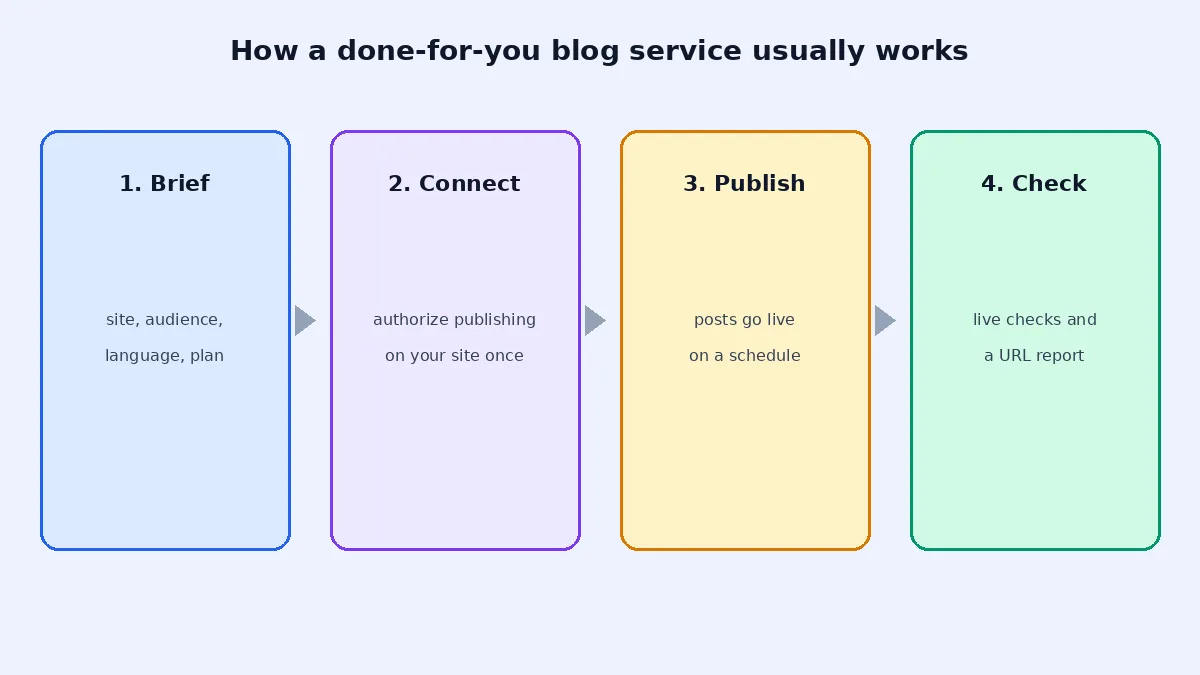
The process usually has four stages:
- Brief. You share your site, who you sell to, the content language and the plan you want.
- Connect. You give the service a way to publish: a CMS user, a plugin, or a signed webhook that only accepts posts from that provider.
- Publish. Posts go live on a schedule with titles, meta descriptions, internal links and images.
- Check and report. A good service confirms every post is actually live and sends you a list of URLs you can open yourself.
Whatever the provider promises, the content still has to meet the standard Google describes in its guide to creating helpful, reliable, people-first content: written to help a reader, showing real expertise, and not produced mainly to attract search clicks.
Is a done-for-you blog right for your business?
It tends to fit when three things are true. First, your customers search for answers before they buy: “how much does it cost to…”, “what should I check before…”, “X vs Y”. Second, you can explain your business clearly in a short brief, so a writer can stay accurate. Third, you want consistency more than you want to write every word yourself.
It fits less well if your topic needs licensed expertise in every sentence (medical, legal or financial advice), if your offers change weekly, or if you have no website you control. In those cases, an in-house writer or a specialist editor is usually the better spend.
What you should keep, and what you can hand off
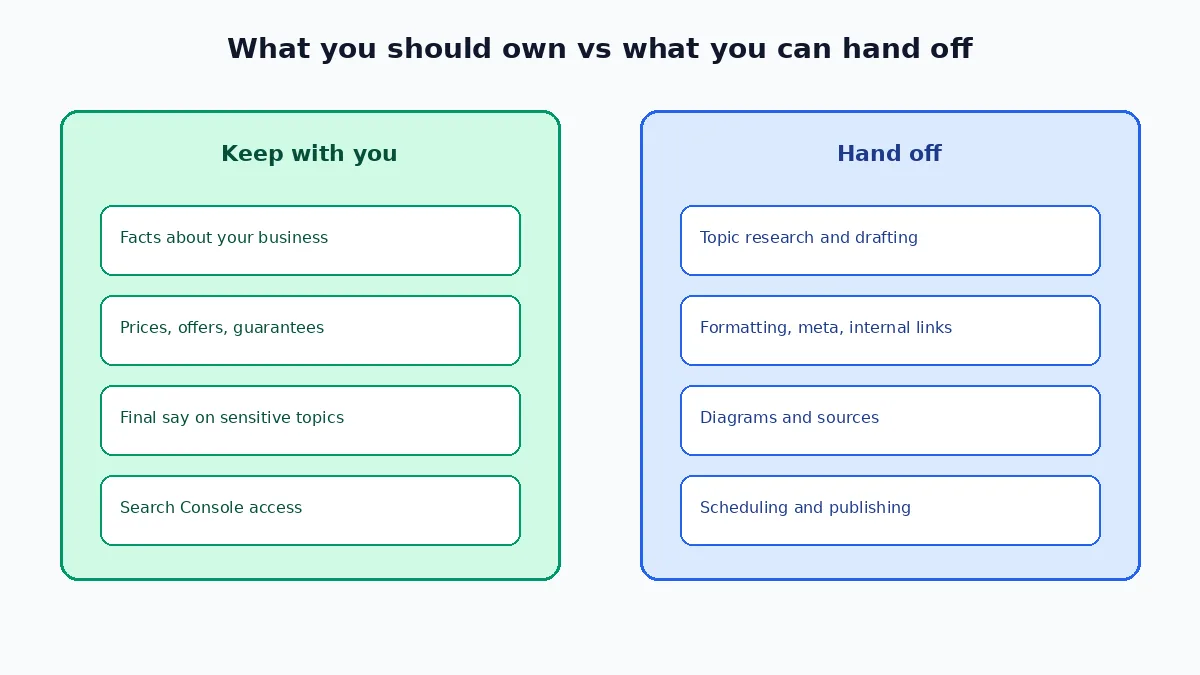
Outsourcing the writing does not outsource responsibility for what your site says. Keep these with you:
- Facts about your business. Prices, service areas, guarantees, delivery times and refund terms should come from you, not from a writer’s guess.
- Sensitive topics. Anything about health, money, safety or legal duties deserves your review before it goes live.
- Search Console. Keep ownership. Google’s own advice in “Do you need an SEO?” is to grant an outside provider read access first, not write access.
You can safely hand off topic research, drafting, formatting, meta descriptions, internal links, diagrams, source-finding and the publishing schedule. That is where most of the hours go.
Six questions to ask any provider before you buy
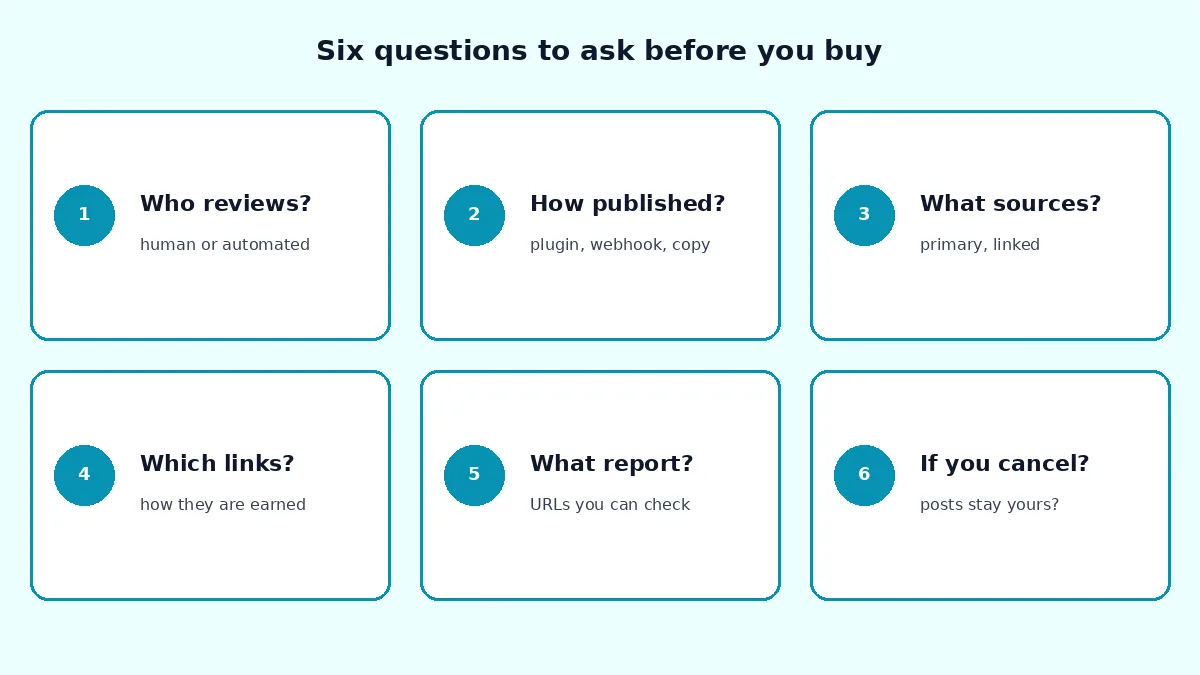
1. Who reviews the posts?
Ask whether a person reads every post before it goes live, or whether the pipeline is fully automated with automatic checks. Both exist. Google’s guidance on using generative AI content says to focus on accuracy, quality and relevance and to fact-check AI-generated content, so if nobody reviews posts before they publish, plan to spot-check them yourself. Our Autopilot plan, for example, is fully automated: posts include sources and are checked live after publishing, but there is no human review, and we say so on the plan.
2. How do posts get onto my site?
A shared admin password is the weakest option. A restricted CMS user, a plugin with limited rights, or a signed webhook that verifies every request is better, because you can revoke it without changing anything else. PilotaSEO publishes through a signed webhook that you authorize once.
3. What sources do posts use?
Helpful posts link to primary sources: official documentation, regulations, manufacturer specs. Ask to see two sample posts and click their links. Posts with no sources, or with sources that don’t say what the post claims, are a warning sign.
4. How are backlinks earned, if any?
Google’s spam policies list “buying or selling links for ranking purposes” as link spam, including exchanging money for links or for posts that contain links. Paid or sponsored links should carry rel="sponsored" or rel="nofollow", as explained in Google’s guide to qualifying outbound links. Ask any provider, including us, exactly how each link is obtained and whether money changes hands for placement.
5. What will I see each month?
The minimum is a list of published URLs you can open. Better reports also show which posts are indexed in Search Console. Be cautious of reports that only show “impressions” or a score from a third-party tool; Google notes that it doesn’t evaluate or endorse third-party SEO tools.
6. What happens if I cancel?
The posts are on your site, so they should stay yours. Check the contract for clauses that remove content, links or images when you stop paying, and check the refund window.
Red flags Google warns about
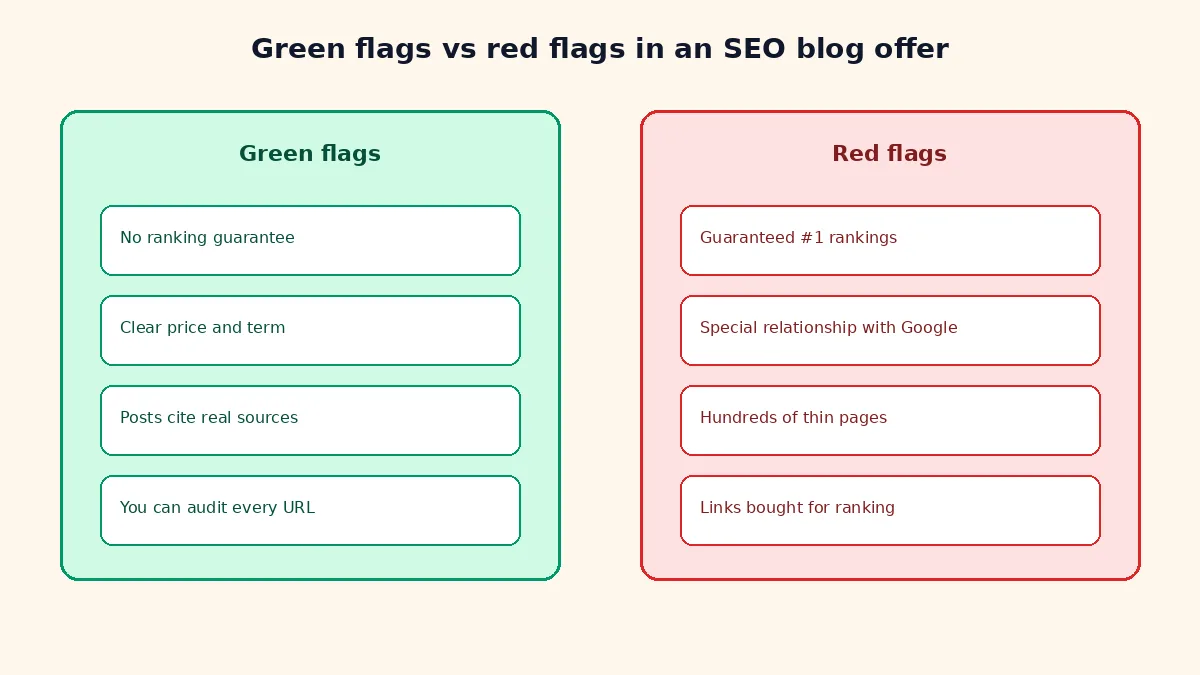
Google’s page for site owners considering an SEO is blunt: “No one can guarantee a #1 ranking on Google.” It also warns against providers that claim a “special relationship” with Google, advertise a “priority submit”, or are secretive about what they will do. Add two content-specific flags:
- Volume over value. Hundreds of near-identical pages a month is what Google’s spam policies call scaled content abuse: “many pages are generated for the primary purpose of manipulating search rankings and not helping users,” no matter how they are created.
- No byline, no dates, no sources. Readers and search engines both look for who wrote a page and when it was last checked. A provider that strips those out is making your site look less trustworthy.
Where PilotaSEO fits
For transparency, here is what our two plans include, taken from our plans section. Both are yearly, prepaid and billed in EUR, and each covers one site and one content language (English or Italian).
- Autopilot, €322 per year. SEO posts written and published to your site automatically, with byline, dates, meta, internal links and diagrams, automated live checks after every post, and a monthly report of published URLs. Fully automated: no human review and no backlinks.
- Growth, €8,250 per year. Everything in Autopilot plus 4–8 editorial backlinks per month from outreach, guest posts and resource pages, with a monthly report of verified live link URLs. Offered when link-building capacity is available.
We don’t guarantee rankings. If you cancel, your plan simply doesn’t renew and every published post stays on your site; a 30-day refund window applies at the start of the subscription. You can’t buy online yet: you send your site URL, plan and language through the contact form and we reply with availability. More answers are in our FAQ.
FAQ
How many posts per month does a small business need?
There is no official number. Consistency and usefulness matter more than volume. A few genuinely helpful posts a month that answer real customer questions beat dozens of thin ones.
Will Google penalize AI-written blog posts?
Google says its focus is on the quality of content rather than how it is produced, and its 2023 statement on AI content says using automation mainly to manipulate rankings breaks its spam policies. The question is quality and purpose, not the tool.
How long before a blog brings traffic?
It varies by site, topic and competition, and nobody can promise a date. Google’s “Do you need an SEO?” page says an SEO audit should give you realistic estimates of improvement, and warns against anyone who guarantees first place.
Sources
- Google Search Central: Creating helpful, reliable, people-first content
- Google Search Central: Do you need an SEO?
- Google Search Central: Spam policies
- Google Search Central: Guidance on using generative AI content
- Google Search Central: Qualify your outbound links
- Google Search Central Blog: Google Search’s guidance about AI-generated content
More from PilotaSEO: all articles.
General information for business owners, not legal advice. Plan details are as listed on pilotaseo.com on 2026-10-08 and may change; the plans section is the current reference. Quotes from Google Search Central were checked on 2026-10-08. Last verified 2026-10-08.